Monday, December 7, 2009

O! Tannenbaum!

'Tis the season of bringing a piece of nature indoors, be it a real or fake Christmas tree.  As a child, we had real trees culled from various Boy Scout troops, church parking lots, hardware stores and a few memorable trips the tree farm.  The last trip to the tree farm was, well, miserable. 

Imagine, if you will, me and my little brother loaded up with the family dog in the giant early 80s Ford tooling down the road on a cold snowy day, my parents juiced up on coffee and Christmas cheer.  There may have even been carol singing.  We and about a hundred other yuletide families wrestled our way through the gravel roads threading in between the farms various outbuildings.  Hand painted signs pointed to where to find firs, spruces, and pines.  Dad discovered very soon that one lane dirt roads do not stay frozen when it's above forty degrees out.  We slogged through mud holes and icy puddles until finally parking the car in a pull off.  Dad was swearing to high heaven under his breath as we tumbled out, dog and all.  Boo, the dog, decided to mark every tree for himself.  No one could decide on a tree, there was something wrong with all of them.  My brother and I were cold, muddy, and fighting.  Finally, a tree was decided on.  Dad went to work with the hand saw (swearing continued) and at last we had our very own overpriced Christmas tree.  I and my brother were tasked with making sure it stayed tied down to the roof of the car, icy winds whistling through the cracked open windows.  Now that's some magical family time.

It depends on the year and our schedules whether we put up a real tree or just decorate a small fake one.  I love the scent of fir in the house and the cats enjoy a new water dish in the tree stand.  We have an old cast iron beast of a tree stand nailed to a piece of plywood.  Works like a charm and it's heavy enough it doesn't fall over, not that anyone has tried to climb it, thank God.  The University of Illinois Extension Service has some great tips for choosing and caring for a live tree: http://urbanext.illinois.edu/trees/selection.cfm.


A real tree in all its glory.


Fergus and a friend enjoying the velvet tree skirt.

Wednesday, December 2, 2009

Light in Winter

As the sun is lowering in the sky and days are shorter, I find the light turns almost silvery in winter.  The trees have lost their leaves and their interwoven branches are gilded in the sun.  We often speak of four-season plants and sometimes it is difficult to articulate to someone why I choose something for winter interest because we often focus on berries or evergreen leaves.  I plant for bark and shape more than fruit or flower.  The birds will clean out the neighbor's crabapple, but I'll still have its charcoal bark and gnarled limbs to admire outside the study window.  The flowers of my beloved China Snow Pekin lilac tree (Syringa pekinensis 'China Snow') are spectacular for three weeks in June.  The graceful limbs and peely bark are stunning backlit or dusted in snow. This year, I was able to be pretty ruthless in the pruning and shape it in the directions I want it to go.  I'm very pleased with how it is becoming more oriental in architecture. It's growing about two to three feet a year and nicely blocks the neighbor's deck and play fort.  The squirrels find it a convenient highway along the fence and a launching point for attempts at the bird feeder.  I leave the seeds on because I think they add a nice tawny brown to the winter landscape.  Fortunately, the little seedlings are very shallow rooted and easy to pull.  If you have a full sun spot with good drainage, Pekin lilac is a terrific small to intermediate sized ornamental tree.  The eighty-year-old ones at the Morton Arboretum are somewhere around fifty feet high, so I'm wouldn't plan on this being a small plant.  Mine is approaching the twenty foot mark in just a few years.


Isn't that bark gorgeous?


Finally becoming a tree instead of a really big shrub.

Sunday, November 29, 2009

Grass is a Glorified Groundcover

Like most homeowners, we have a lawn.  It's pretty big, even though I expand the beds each year.  Slowly but surely, I'm chipping away at it.  We do not have a lush, green, carpet.  Nope, sorry.  It's a mix of grass and "weeds."  We just don't care to pour pesticides on our patch of green or water it when it goes brown and dormant.  It's groundcover, not a full time project.  Fortunately, our neighbors tolerate our quirky mix of Kentucky bluegrass, crab grass, violets, dandelions, creeping Charlie, clover, and whatever other green things have wandered in.  I'm getting rather fond of the barren strawberries that have gained a toehold in the back corner.  We mow, of course, but pretty high and we mulch the clippings. 

About three years ago we forgot to do the spring weed and feed.  That summer we got some nifty bugs.  So, we did away with the weed and feed to see what would happen.  I'll yank out the thistle that grows from last winter's birdseed by hand.  Each year we have more interesting beetles, bugs and spiders, and more birds.  These things are much more important to us than a perfect lawn.


Isn't he pretty?

Friday, November 27, 2009

New Dawn - An Easy Climbing Rose, Not a Stephanie Meyer Book

I've heard it a thousand times - "Roses are too fussy!" "I can't grow roses." "Roses don't like me."  Pshaw.  Roses like you fine, you just need to find the ones best suited for your temperment and your situation.

I am not a fussy gardener.  You have to be tough to survive in my yard and handle minimal watering, rabbits, chipmunks, and the occasional neighborhood cat.  Any rose has to be durable to live in my patch of ground.  No tea roses for me, thank you.  I don't need the hassle.  So, I have shrub roses and the climber New Dawn.

I live in a 1929 Sears catalog kit house and so I tend to plant plants that are in keeping with the period of the house.  We have a soft spot for heirlooms.  My husband loves to plant heirloom veggies and I like heirloom flowers.  New Dawn was introduced ni 1930 and is a vigorous climbing rose with dark green leaves and pale pink flowers.  It is a sporadic rebloomer.  It's big show is in May and then we get a flower here and there before a last hurrah in October.  And I'm not kidding on the vigorous part.  This baby will do about eight feet a year if not more.  I cut it to the ground every three to four years so it doesn't eat the house.  This year was not a good year for roses with our wet spring, and wacky wet/dry, hot/cold spells.  Still my New Dawns did pretty well.  They also don't tend to get black spot or mildew or any of the myriad rose diseases.  They even get nice rose hips for winter!


This is the last flower on one of my two the New Dawns, taken today.  Isn't it lovely? Fragrant, too.

Tuesday, November 24, 2009

Buried Treasure

Ah, spring.  Hyacinth and tulips dapple the garden and daffodils nod from a sheltered nook.  We sigh over crocus and are thankful that some sign of life appears after another brutal Chicago winter. 

However, for this magic to happen, we plant the little darlings now.  I will confess to having a rather free-for-all approach to bulb planting.  I do take precautions for tulips, as I have an active and growing chipmunk population turning the front raised bed into luxury chippie condos.  I like to coat my tulips in bulb dust by putting a couple of tablespoons or so in a paper lunch bag, dropping in the bulbs, and shaking to coat evenly.  Bulb dust has nasty garlic, chili pepper, and other icky tasting stuff in it. 

I have patches where I have planted in sequence with a color scheme in mind, but only a couple.  I tend to dot in daffodils where I know perennials will fill in and cover their foliage as it wanes.  I did create a river of grape hyacinth (Muscari sp.) that is holding its own for the most part.  But, I like surprises in spring.  Quite frankly, I have no idea where all my bulbs are planted and I like it that way.

This year, I will start the scilla (Scilla siberica) project.  In the historic district of my town, a handful of homes have scilla lawns.  What is a scilla lawn?  Imagine a carpet of tiny blue flowers flowing through the lawn into beds and around trees.  Since scilla blooms before you're ready to cut the grass, you have a stunning sea of color with minimal fuss.  That is, after you plant the cursed things.  I am starting with fifty and will add more each year.  Are they planted yet?  Heck, no.  Hey!  The ground isn't frozen yet.  I've got time. 

For a little taste of spring, here are a few crocus and one of my Katherine Hodgkin bulb iris.  I promise to post the scilla as they progress.


Friday, November 20, 2009

Transplanting Trees - or How We Did Not Manage to Kill Dave

As you may have noticed, I'm a bit of a tree geek.  Let's face it - I'm an uber tree geek.  They fascinate me - the roots, trunks, branches, buds, leaves - all of it. I can talk about trees for days.  I can identify them at 60 miles an hour.  My family graciously puts up with me and refuses to play Name That Tree.  Sometimes they are No Fun.

My favorite tree is the elm.  Katsura, beeches, and oaks run a close second, but elm is my doomed love affair.  I grew up in a suburb with elm lined streets creating leafy tunnels and squirrel highways.  I watched them felled year after year by Dutch elm disease.  I can give you the history of Dutch elm and the elm leaf beetle that is the disease vector, but I won't. It was identified in Holland, thus the 'Dutch' part of the name.  There is NO type of tree called Dutch elm!  I once came across a novel where the protagonists strolled under Dutch elm trees.  I believe I threw the book against a wall in disgust. 

Anyway, I attended a lecture years ago given by Dr. George Ware at the Morton Arboretum on elms.  Dr. Ware was one of the preeminent elm scientists and is responsible for many of the disease resistant cultivars now on the market.  He lived and breathed elms and still came into the Arb even though he's retired.  He asked the class if anyone wanted an elm seedling as he was testing some new saplings grown from seeds collected in China by Dr. Kris Bachtell.  Oooo!  A free elm!  How could I resist?  It didn't matter that I was living in an apartment in Evanston at the time.  My in-laws graciously planted it in their yard until the day we could buy a house.  It's an Ulmus davidiana or David elm, thus my mother-in-law christened it Dave.  He was only as big around as my thumb and very cute. Yes, trees can be cute.  Shush.

Fast forward two years, and there we are, new homeowners.  Time to transplant!  However, Dave, being an elm, had grown.  A lot.  Now he was two inches in diameter (or to be technical, two inch caliper DBH (diameter at breast height)) and quite a bit taller.  Hmmm. Some shovels, burlap, as well as me, my husband, and father-in-law set to work.  Hours later after much digging, hacking, piano wire, and cursing, we had managed to wrestle Dave from the ground.  Guess what?  Elms can have a tap root.  By the time we'd loaded him into the family minivan, the root mass was pretty dodgy looking and losing soil.  Still, we planted him in the front yard (a shade too deeply in hindsight), watered him in and hoped.

Eight years later, Dave is lovely.  He is gorgeous.  He's survived major pruning, cicadas, and the neighbor kids.  He is well on the way to being a stunning, vase-shaped shade tree.  Birds nest in his branches each year.  This year, the neighbors' elm succumbed to Dutch elm due mainly to shoddy pruning practices.  If you have elms, don't prune them in July, even if the branches interfere with your fire pit.  Elm leaf beetles are attracted by open wounds and stress.  Only prune elms in winter when insects are dormant. We are watching Dave like hawks, but so far, no signs of it. 

If you are going to transplant trees, do it as young as possible.  Once they are at the two to three inch caliper DBH, it gets much more challenging and requires more than one person and the proper tools.  Call your friends and buy them beer and pizza. You can find landscaping companies with tree spades (Picture a huge three bladed machine that can stab down and lift a whole root ball.  They are really cool!), but it is thousands and thousands of dollars to move large trees.  Trees should be planted so that the root flare - where the trunk starts to flare into the major roots - is at the soil line.  The soil that you dug out of the hole goes right back in.  Trees will adapt to where they are growing without major amendments.  Plants are stubbon!  They really want to survive!

Here is Dave in his 2009 fall glory. Isn't he cute?

Wednesday, November 18, 2009

The Architecture of Oaks

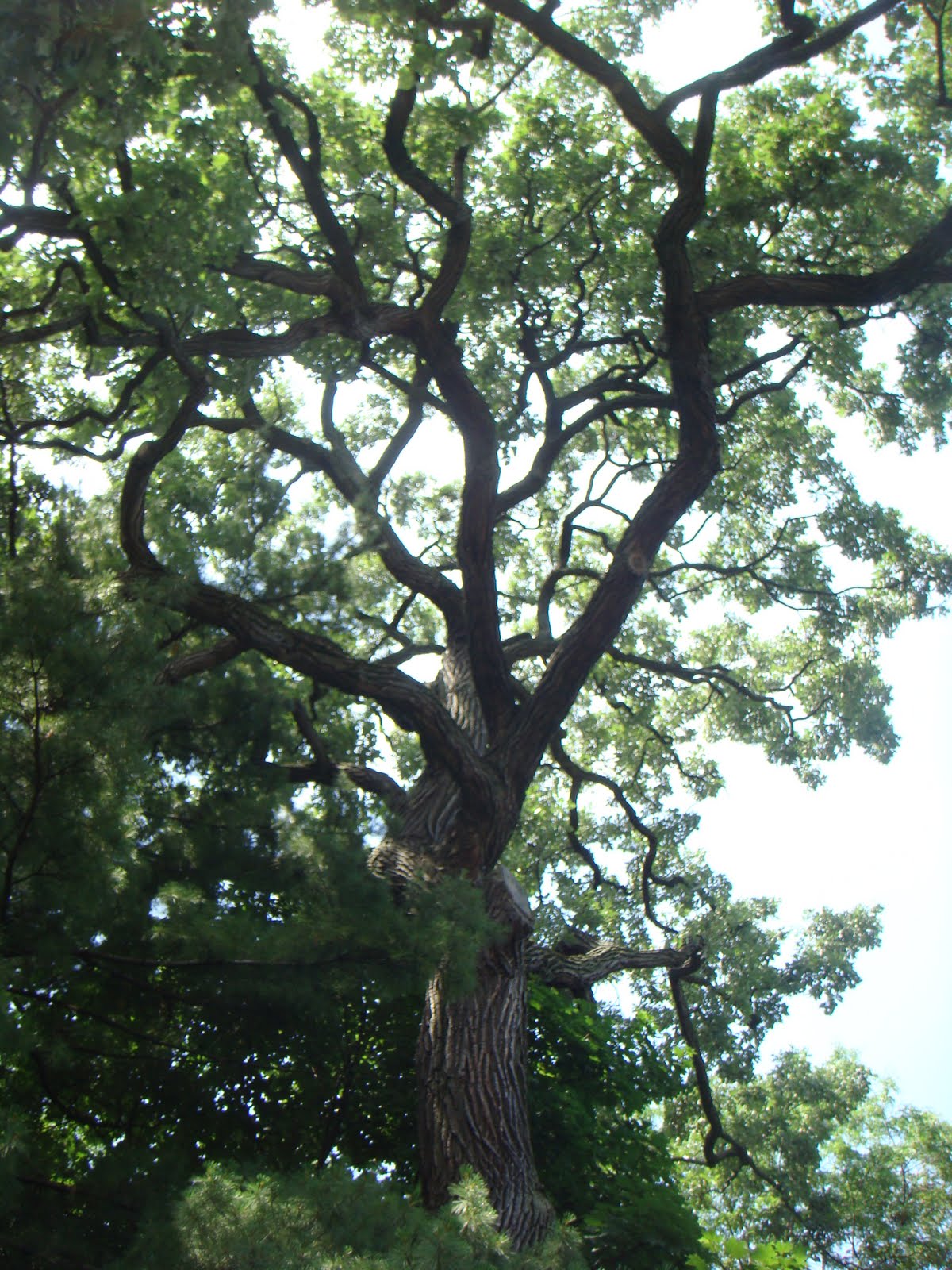
Few things are more magnificent than our native oak trees.  Towering above us, some of these beauties are nearly 300 years old and have survived fire, flood and farmers.  Bur oak (Quercus melanocarpa) has the thickest, most corrugated bark.  These crusty giants can withstand prairie fires and shed distinctiver shaggy capped acorns.  It grows very large and each one has an individual shape with gnarled and twisted branches.

White oak (Quercus alba) is our state tree and is very straight and upright.  It has smooth, fat acorns and can turn russet in fall.  We are losing them as development creeps in.  One friend of ours recently had to take a white oak down due to age and disease.  Yet, by using a certfied arborist and professional forester, he was able to harvest the lumber and is using to make furniture for his family.

Red oak (Quercus rubra) wants to be a wide and spreading tree.  You'll find limbs going straight out for yards and yards if it has enough room.  Red oak acorns are delightfully pointed and it turns a deep red to wine in fall.  This is one of our oaks that grows very fast - some years two to three feet!

These are a mix of all three oaks, each with its own personality.