Wednesday, May 4, 2011

Mmmmmmmm....Magnolias!

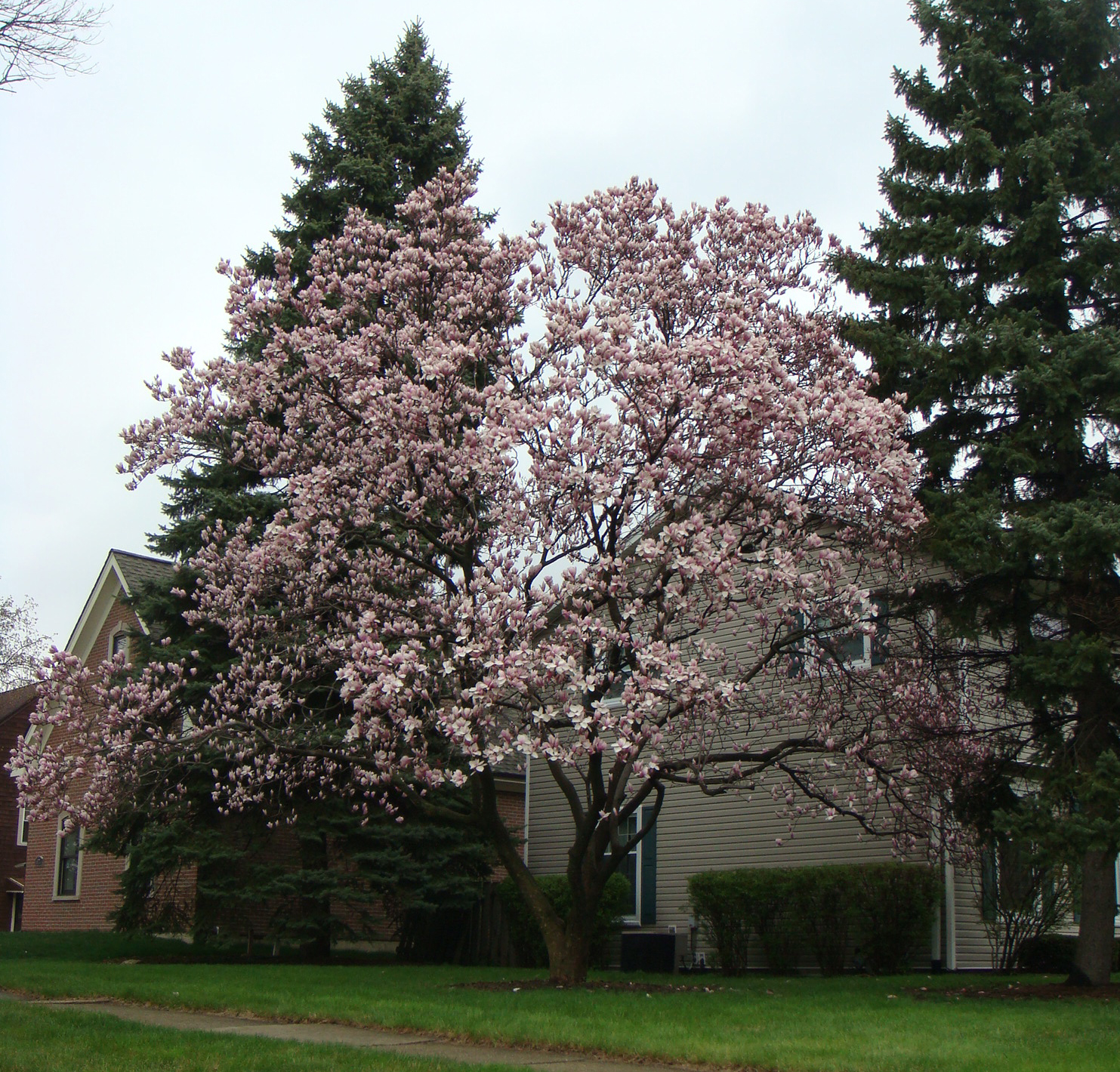
This had been an outstanding year for magnolias.  We have managed to elude a late frost so the star magnolias (Magnolia stellata) have held much longer than normal. Now the saucers have taken the stage.  I'm fortunate to live in an old neighborhood, so there are lots of mature grande dame Magnolia x soulangiana gracing the streets and lawns.

Isn't she pretty?

Magnolia is a very ancient tree - it evolved before bees. The whorled leathery petals of its flowers were designed to attract beetles instead. There are fossil records of magnolia go back somewhere around 20 million years, although there is evidence of the plant family back to 95 million years. Charles Plumier in 1703 had the audacity to name a flowering tree he found in Martinique after the French botanist Pierre Magnol and it was generally accepted after Linneaus thought it catchy. Ironically, Linneaus never saw a specimen and took it for the same plant described in Mark Catesby's Natural History of Carolina, Florida, and the Bahama Islands. It all works out in the taxonomic wash, though.


Trust me, it's whorled.

I haven't planted one.  Why?  Because they only look good for a week, and sometimes, not even then.  If we get a late frost, they look like they're covered in wet handkerchiefs as the flowers aren't frost tolerant.  Yes, they have nice big leaves and smooth grey bark, but I have limited space and a long list of trees to plant.  So, I try to go for walks around the neighborhood to visit with everyone else's trees.  There's also a nice collection at The Morton Arboretum, and I am particularly fond of a few on the West Side along Joy Path.


Wednesday, April 27, 2011

Daffodil Traditions

Some day it will stop raining.  Today is not the day.  So, to perk myself up, I've got daffodils.

From Wordsworth we have the lovely poem 'I Wandered Lonely as a Cloud' and its daffodils.  I have sprinkled them through the beds, purposefully forgetting where.  They are thriving in the sunniest bed, of course and I manage to have about six weeks of daffodils.  The ones near the driveway came with the house and it is probably past time to dig them up and split them.  Daffodil bulbs will multiply and form almost a volleyball wad of tubers over time.  The critters don't eat them, so they really are an easy bulb.

One of my favorite traditions is visiting Daffodil Glade at The Morton Arboretum.  The project was started in early 30s when Joy Morton was still alive.  There are thousands and thousands and thousands of daffodils now.  The Arb has continued the tradition in recent years and now daffs are sprinkled in spots along the East Side and at the entrance.  Families visit every year and take pictures among the blossoms. 

The Prince family tradition has been to give the first daffodils seen in the grocery stores to my mother-in-law as it is one of her favorite flowers.  This used to be more of a competition before markets started selling imported Irish daffs.  So far, my father-in-law usually wins.

Friday, April 15, 2011

Houseplants I Have Not Yet Killed

It's time for an update on my houseplant purchases from Hausermann's! 

I have not yet killed them!

See?  Isn't it cool?

The orchid is blooming nicely and seems to be very happy.  It's leaves are healthy and the cats haven't knocked it to the floor. 


My one gardenia flower!  So fragrant it filled the study.

However, the gardenia is pissed off.  We just don't have enough humidity in the house to keep  it happy.  It's dropping leaves and now has a case of spider mites.  I'm trotting it down to the basement sink and dousing it with a strong stream of water regularly.  Spider mites can't swim very well.  I'm not sure I'll get another flower out of it, but it was magical while it lasted.  We shall see.  I'm determined to keep trying!

Wednesday, April 6, 2011

Chives: The Herb of Spring

Chives!  There's some daffodils growing in
the middle of a clump that reseeded itself.
Works well!  Daffodils die down, chives keep on going.

In our house, we know it's spring when we can harvest the first chives.  Perhaps it is my Norwegian heritage that likes to put chives and fish together. Chives always make me think of smoked salmon on rye bread and lots of hot tea.  I'm only an eighth Norwegian, but it crops up out of nowhere sometimes. For me, chives signal spring foods like salads, peas, tender lettuces, and radishes.  There's a sense of throwing off the heavy, sustaining foods of winter and a deep longing for fresh flavors and lightness.

We have lots of chives because I never quite catch all the flower heads before they go to seed.  At this point, they are about six to eight inches high and the perfect size to harvest.  Here are some suggestions on how to use chives that are quick and easy.  I find I prefer to use them as a finishing touch as they don't hold up well to lots of cooking.
  • Sprinkle on scrambled eggs, fried eggs, really any eggs, just before they come out of the pan.
  • Whip chopped chives with cream cheese and/or yoghurt as a spread for bagels, especially with lox!
  • Mix chives with mayonnaise for a great herb mayo for sandwiches.  You can do small batches and keep it tightly sealed in the fridge for days.
  • Mix in chopped chives to egg salad, tuna salad, and hashes.
  • Toss with salad greens for a nice oniony zing or add to your homemade dressings as a finishing touch.
  • Include when cooking fish in paper along with olive oil, capers, and slices of lemon and lime.
What are some of your favorite ways to use chives?

Monday, March 28, 2011

Crocus: Pearls of Spring

Each day I walk the property, carefully noting signs of spring.  Sometimes the changes are tiny and sometimes flowers appear out of nowhere.  This year the crocus did the magic appearing act.  My very early ones, Blue Pearl and Cream Beauty are fading fast, but of course, I have pictures.  These little guys are growing in the lawn where there used to be a purple plum tree.  

Isn't Blue Pearl cute?

And a dash of Cream Beauty

My next crocus to appear on the scene are larger and I'm afraid I don't know the cultivar.  I thought I kept the bag, but no.  So, they are mystery crocus with singularly glowing stigmas.


We also have planted a smattering of crocus at work and so here's some lovely white ones to round out the crocus gallery.

Small, but lovely!

Crocus are native to Europe, North Africa, the Middle East, Central Asia, and all the way to China.  We get saffron from the stigmas of the autumn blooming Crocus sativus, which doesn't really grow here.  Think about how many strands of dried stigmas make an ounce of saffron and you understand why it is one of the most expensive spices in the world.  Crocus has been cultivated as a flower in Europe since the 1560s and European settlers brought them along to the U.S.  For me, I'm a huge fan of anything that blooms early and I try to plant a handful of crocus each year.  I purposely forget where I planted them.  I like to be surprised.

Thursday, March 24, 2011

Pruning Dave the Elm

Yes, it's the season - pruning season!  You may be familiar with Dave the Elm from an earlier posting.  I'm not emotionally attached to the annuals, bulbs, or perennials, but my trees and shrubs are something else, especially Dave.  Trees do best when they have good structure and Dave was, well, rather unkempt.

Very shaggy!

You should prune elms between November and March when the insect population is dormant to minimize the risk of Dutch Elm Disease spread by elm leaf beetles.  We've had two elms within about a block succumb to Dutch Elm and Dave has been squeaky clean.  I asked my friend B, a certified arborist, to come and clean out Dave as he's just a bit large for me to handle.  I cannot stress enough using a certified arborist to work with your trees.  I have made the mistake once of having a removal done by some guy with a truck. Never ever again.  Certified arborists have been trained and must continue their education to keep their certification.  They work with trees daily, and really understand structure. Plus, they have the right tools and safety gear for the job.  B was roped in, not just hanging off a ladder.

Pruning, pruning, pruning

B and I were quite aggressive, but it was very necessary to make sure future growth is going the direction that we want.  Dave also had quite a few dead twigs due to the cicadas of 2007.


All done and elegant!

Isn't he lovely?  The robins might be a bit pissed off as we took out one of their favorite branches, but I'm sure they will manage.
Thursday, March 17, 2011

Invite the Garden In: Tablescapes

I love a pretty table setting.  I adore dishes.  I swoon over linens.  So it is with great interest that I wander through the tablescape exhibits at the Chicago Flower & Garden Show.  When I entertain, there are flowers or some kind of plant decoration involved, and I like to get new ideas.

Dramatic, elegant, a punch of color

For me, the above setting is very urban chic.  The clusters of yellow daisies should be fairly easy to do with some wet floral foam and floral wire if the daisy stems aren't stiff enough to pierce the foam.  I like this because of the dramatic use of one color.  The yellow just really jumps out at you.

Very spring!

I found this centerpiece quite lovely and I liked the element of blue wire wrapping the tulip especially.  For me, this is a nice fresh take on a spring bouquet, and again, fairly easy to do.  Remember, wet floral foam is your best friend for striking arrangements. With this type of arrangement, you need to think about simplicity in form and the rule of odd numbers.  There's only five tulips and five yellow flowers, but the way they are placed gives it a sense of rhythm and movement, yet it's playful too.

Speaking of playful...

Flowers as food?

This is just fun with carnations.  The nice part about carnations is that they are very long-lasting and easy on the pocket book. These managed to hang out in the hot dog buns for a week and still look pretty good.