Friday, September 2, 2011

Raising Butterflies

This summer, I've had a chance to revisit my childhood of bug collecting. I love bugs. Any and all of them. I'm fascinated by the insect world, the creepier and crawlier the better. As a kid, I had a mayonnaise jar filled with random insects found around the yard. Ask my mother! She swore I'd be a naturalist counting bears with Grizzly Adams in the Rockies. Little did she know all that tree climbing would lead me into horticulture.

With our big butterfly festival at the garden center this August, a bunch of us have been raising caterpillars.  We wanted to have a butterfly release and give the kids the experience of raising butterflies. I have been the proud mama of one monarch and three pipevine swallowtails. Finally, today, the last of them emerged from the chrysalis and fluttered to freedom. The monarch egg came from my own milkweed plants, but the three pipevine swallowtails were collected with permission from The Morton Arboretum.

This has been really an amazing experience. Being able to witness firsthand the transformation of a creature from egg to caterpillar to butterfly really makes you think about the complexities of nature and the compelling drive of life.  If you can, I highly recommend raising a butterfly or two if only to have your wonder of the natural world restored. Besides, they are very very pretty.

This is Millicent the Monarch, freshly hatched.

These are Alphonse, Beatrice, and Cameron munching away on Dutchman's pipe vine.

Millicent chowing down on common milkweed.

Almost full grown swallowtail caterpillar. He formed a chrysalis the next day.

This is not Millicent, but one of the monarchs at work shrugging off its caterpillar skin and becoming a chrysalis.

These are the boys. One was under a leaf at the time, so he's a green chrysalis.

 Beatrice has to be different and attach to the aquarium lid

Millicent surprised us and here she is crawling out of the pickle jar.

Free at last and still pumping up her wings.

Beatrice emerged this morning sometime. She flitted away and landed on the hackberry once I opened the aquarium.


Just for fun - three stages of black swallowtail hanging out in the break room.


Saturday, August 20, 2011

Building a Beautiful, Low Maintenance Garden in the Sun

Recently, a friend and I journeyed to two gardens influenced by the work of Roy Diblik, a Midwestern grower and Piet Oudolf, a Dutch landscape designer. We are looking for ways to create gardens that are low maintenance, drought tolerant, and densely planted enough to inhibit weeds. Pretty much, Diblik's philosophy, really, but we wanted to see it in action. First, we visited Diblik's Northwind Perennial Farm, just over the border in Wisconsin on a blistering July day as part of a tour offered by the Landscape Design Association. The sunny gardens are magnificent. If you get a chance, it's worth the drive up. The shade gardens are still in development, though. Diblik experiments with new plants on his grounds, so many things are in process. The idea is to create sustainable landscapes that offer four-season beauty and feed wildlife. Not all of the plants are natives, but many are incorporated or cultivars of natives are used. And there's goats. Who doesn't love a nice goat?


Nicely mulched paths run through the sunny gardens. One thing that strikes me especially about these designs is the softness. You just want to run your fingers through the plants. It's hard to capture the movement inherent in these groupings, but I think you can imagine it.


I really love the textures that interplay in these gardens. It's very subtle, but very sophisticated.


Here you see one of Diblik's favorite plants for long lasting color - Stachys monieri 'Hummelo'. The upright pink blossoms bloom for weeks and the tidy green foliage forms a nice, bunny-resistant mound.


Admittedly, it is a lot of pink, purple, and white, but there are lots of ways to add a dash of yellow or orange in these gardens too. We were treated to goldfinches, wrens and swallows swooping overhead as well as too many butterflies to count.


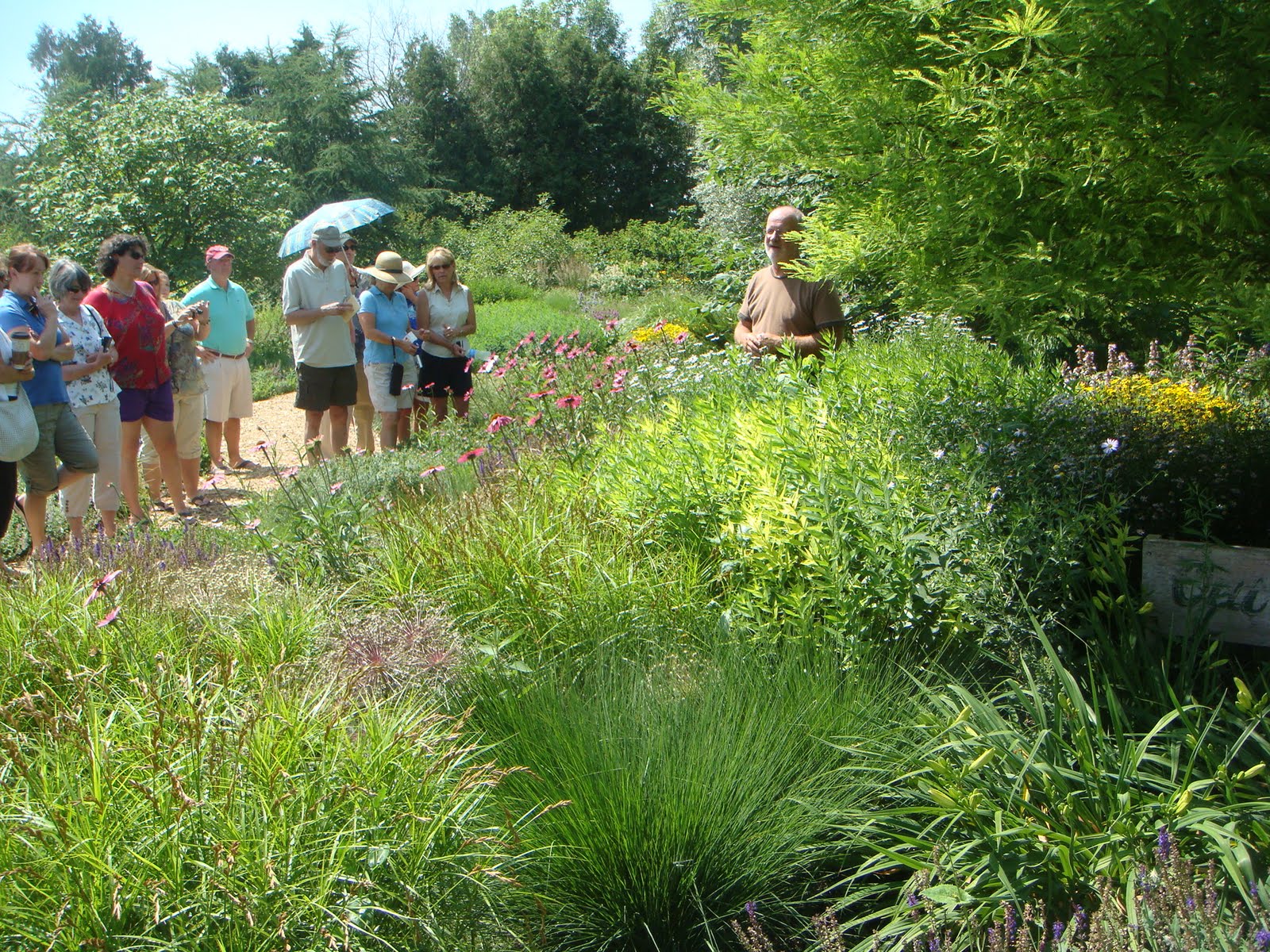
And there's the man himself as we slowly melt into sweaty puddles. These designs are perfect for the hot, sunny site, but there was not a whole lot of shade!

Next, we headed to the far west suburbs to visit the headquarters of Midwest Groundcovers. Midwest is primarily a wholesale grower, although they do have a small sales yard. We successfully controlled our pocketbooks, but not easily. You can also see a similar effect at the Lurie Gardens at Millennium Park.

These gardens are designed by Piet Oudolf and are meant, again, to be four-season interest in full sun with minimal care. Oudolf has used ribbons of plants here so you have a feeling of rhythm.


The soft, needle-like foliage is Amsonia hubrichtii which will turn an amazing golden orange in fall. The little yellow flowers are a threadleaf coreopsis cultivar. I think the stiffness of the echinacea is a wonderful foil for the wispy texture of the other two.


Again, I'm struck by the softness.  Here you can see the ribboning of the echinacea through the bed.


Here we have Allium tanguticum 'Summer Beauty' in the foreground.  It has finished flowering, but as the seedheads form and dry, it still has a stiff texture. The grasses are beginning to flower so you have an almost cloud-like effect in the background.


The white flowering plant in the foreground is Calamintha x 'Montrose White'. This calamint stays put and flowers for about four months. It has spicy fragrant foliage, so the bunnies don't eat it and in full sun emits a nice scent. Insects adore it! You can't tell here, but it is crawling with bees, wasps, flies and other pollinators. These gardens were filled with butterflies and birds, too.


This picture just makes me want to plunge my hands it and pet it. The lavendar flowers are Limonium latifolium or sea lavender. It has broad basal foliage that is a deep green and glossy. When interplanted with the amsonia, the delicate flowers are held upright. Otherwise, the blossoms tend to fall over. This plant is often grown as a dried flower for bouquets.

These two gardens are almost no maintenance, but it will take probably about four years of weeding to get them established. I think they are much more beautiful than a sterile swatch of lawn, don't you?

Saturday, August 13, 2011

Butterflies: Jewels on the Wing

These two Eastern tiger swallowtails are feasting on echinacea, our native coneflower.

It's been a bad year for butterflies. We just haven't seen nearly as many. There's several reasons from heavy herbicide use by farmers to freezes along the migration path to loss of winter habitat in Mexico.  Only in August have we started to see more of our common butterflies like monarchs, red admirals, red spotted purples, skippers and others. At work, we had our first butterfly, bee and bird festival last weekend. We had a great time, but more fun was staff raising butterflies from eggs. You really don't appreciate the miracle of nature until you see a caterpillar split into a chrysalis.

Butterflies are easy to attract with a little planning and a sunny protected site. First, be open to damage. Caterpillars need to eat plants and they can be quite voracious, so lay off the herbicides and pesticides. Also, caterpillars are very particular about their food sources. Monarchs only eat plants in the milkweed family. Swallowtails like parsely, fennel, and dill. Of course butterfly bush will attract butterflies, but our native plants often provide more nutrients. Some pollinators emerge only when their favorite native nectar and pollen source is blooming.

Add a butterfly muddle.  Take a shallow dish or saucer, fill it with sand and top it off with some small flat rocks. Add water and keep it moist and maybe sprinkle some salt from time to time. Butterflies can't handle the water tension of a birdbath and love a little extra salt. You can also add some pieces of fruit, but by and large, butterflies are attracted to feces.  Well, someone has to.

The Morton Arboretum has a terrific list of plants for nectar and larvae. Check out the Xerces Society for lots of information and to become more involved in butterfly and polllinator conservation. For identification, try Butterflies and Moths of North America.  You can also report sitings and keep track of what's been seen in your area.

Thursday, August 4, 2011

Japanese Beetles: Get Over It

Hi there!

I don't think I do this often, but on this topic, I'm going to drag my soap box out and dust it off.

People - get over the Japanese beetles!

They're here to stay, they aren't as damaging as you think, and for Pete's sake stop poisoning the environment with Sevin and imidicloprid trying to get rid of them. If you're a grower or a farmer, it's different. You are growing plants as a saleable crop. As a homeowner, learn to accept a little damage.

We are winding down on Japanese beetle season. However, I still have many people wanting to know how to get rid of them. First, here's a roundup of links to the experts:
U of I Extension
The Morton Arboretum
Chicago Botanic Garden

What do I do in my yard? I pick them off and stomp on them, knock them into a container of soapy water, or just ignore them.  I don't have very many, so for the three weeks they're feeding, it's not that big a deal. For God's sake do not use beetle traps. They just attract all the beetles in the neighborhood so they can lay eggs in your lawn.

I have had stories from many people. I've had two ladies proudly proclaim that using Raid on all their flowers killed the beetles. Of course one of them then asked me why she's finding dead birds all over her yard.  Hmmmm... I've also had folks tell me that they removed plants because they couldn't handle the beetles eating them every year. In one case it was a ten foot high Harry Lauder Walking Stick (Corylus avellana 'Contorta'). Do you know how long it took for that plant to get that big and what a tremendous loss it is? Another fellow bought an old farmhouse and cut down the gigantic rose bush on the side of the house because it got eaten. That rose bush probably was a cutting from some pioneer's grandmother and we'll never know what precious heirloom plant was wantonly destroyed because someone couldn't deal. As you may notice, this practice sets my hair on fire.

Here's my favorite fun fact about this season: Plants (woody plants in particular) have stored enough resources by mid to late July to ensure that they will get through the winter into next spring. Any food production after this point is just gravy. Japanese beetles will not kill your plants unless they are already stressed by other factors.

So, please, lay off the poisons that kill the bees and just pick and squish. It's very therapeutic, I promise.

Tuesday, July 12, 2011

Summer Sparkler: Bottlebrush Buckeye

Although Independence Day has passed, I still have fireworks in the garden.  July is peak season for a number of perennials like monarda, hollyhocks, and daylilies, but one also one of my favorite shrubs. Bottlebrush buckeye (Aesculus parviflora) is a large shrub for part to full shade.  It is doing quite well under the spruces, which means it can handle the Evil Dry Shade of Doom despite Dirr and others saying otherwise. Thank God, something is happy there. It's a continual test labratory for pushing the tolerances of plants. I planted Carex pennsylvanica this year.  We'll see how it does, as it is one of our native sedges that supposedly can handle drier soils.

One big one and one small one

Bottlebrush buckeye is not for the small garden, really.  It wants to be at least ten feet high and it will form large suckering colonies. Introduced in 1785, it is native to South Carolina, Georgia, etc., although grows very happily in my zone 5 garden. William Bartram first noted the plant and it is still in his Philadelphia garden as of 1930. I can't remember if I saw it there when we visited a few years ago. John Fraser, though, was the first to introduce it to the British horticulturists and gardeners. I put it in the shrub border I'm building between us and the neighbors.  In winter, it's leggy habit is very see-through, but in full leaf, it is an impeneterable barrier.  Then it blooms. The soft white flower spikes on these beauties can be nearly 18 inches tall. The flowers can last a very long time, and I tend to leave them up.  Occasionally, you'll get a fruit. 

Aren't those flowers spectacular?

Purchasing this plant in a garden center can be an expensive endeavor. Bottlebrush buckeye is notorious for being difficult to propagate on a commercial basis. Why? It is tricky to cultivate from seed and cuttings. My little one is from a friend and the larger one was purchased at the Morton Arboretum's annual plant sale.  Both of them are suckers from larger plants and the first year I did water the hell out of them. Now they are cheerfully sending up their own suckers and filling the area slowly. Hooray! I'm looking forward to having many more years of dazzling blooms.

Friday, July 1, 2011

After the Affair: Storm Damage

When tornadoes blow through my town, many many trees come down. Unfortunately, the sirens didn't go off, so my husband and I being the weather geeks we are, watched the whole thing from the front windows. I knew it wasn't your typical thunderstorm when the hackberry out front started to literally twist in the wind.


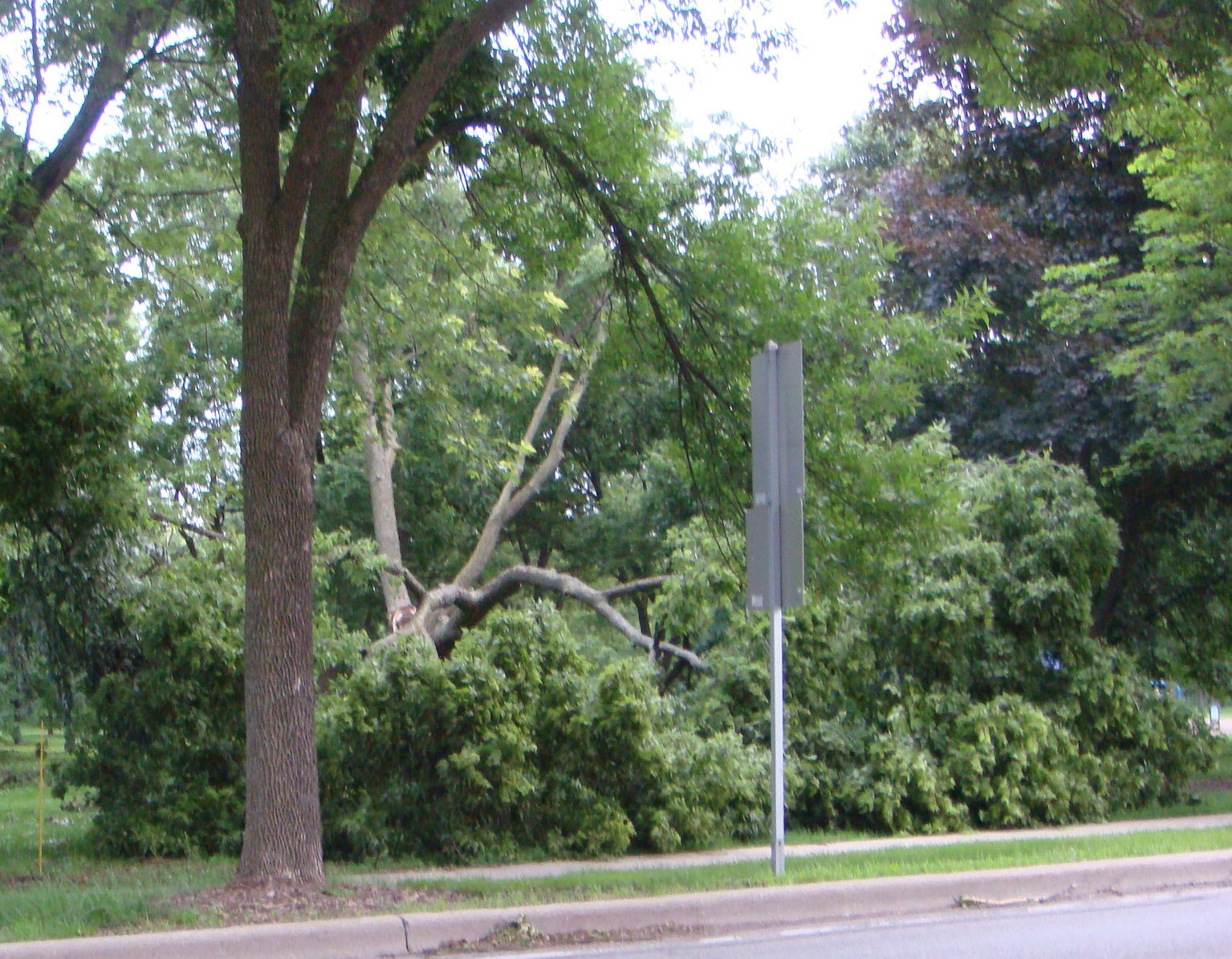
This one split in two at a bad crotch where rot had set in.

We were very lucky. There were just a few branches down from the aforementioned hackberry and the ashes across the street.  Touring the neighborhoods, though, we saw huge limbs and whole trees down on top of houses and cars. My parents called to tell me half an elm tree went through the neighbor's kitchen.


An ash took out about half of the Kentucky coffeetree in the parkway.
We'll see if the village keeps the parkway tree, but I'm doubtful.

So, what to do now?  The village has hired a legion of tree companies to clean up the damage and it is slowly getting done. We'll see what the ongoing plan will be for trimming, removal, and replacement. Most of the downed branches seem to be from old ash, silver maple, and Norway maple. There's a smattering of black walnut, catalpa, linden, and one ancient oak tree that I've spotted, but mostly ash and maple. I am not surprised. The giant ash trees on my street drop branches if you sneeze on them and silver maple is a weak tree. We now have the opportunity to replace them with a broader palette of trees. I'm just thankful my baby beech made it through without a scratch.

The U of I put together a nice article on what to do with storm damage. Mother Nature is in charge, but if trained well when young, trees can survive an amazing amount of stress.

Wednesday, June 15, 2011

A Lilac Like No Other

Just beginning to bloom on the west side.
June is the season of tree lilacs.  Japanese lilac (Syringa reticulata) and Pekin lilac (Syringa pekinensis) are perfuming the air and delighting the eye with their large fluffy creamy white flowers. 

I chose China Snow Pekin lilac when I planted about nine years ago for its peeling bark.  I'm only allowed one peely bark tree since my husband grew up under a sycamore and is still scarred by the experience. After much deliberation, I chose lilac. The lilac is now right around 20 feet high and this year it's just spectacular.  Somehow the right mix of weather has allowed it to bloom along the branches in some places, almost three feet!

I positioned it to screen the neighbor's deck from view, and both of us really love this tree.  I think the fragrance permeates the whole block. Yes, it suckers. Yes, it seeds. Both problems are pretty minimal in the long run compared to the winter beauty of the bark and the incredible June flowering. It also grows like a weed, but most of my trees and shrubs outperform expectations. I credit the excellent soil I inherited. The new baby beech tree has already put on six inches - so much for slow growing!