Monday, January 28, 2019

Amaryllis for Sanity or Flower Power in Winter

Amaryllis 'Amadeus'

This week, Chicagoland is taking a page from the tundra and dipping into perhaps historic lows in the negatives. So of course...my first amaryllis bloomed! The other three are dragging their little green feet. I don't really mind. January, I can tough out. It's February and March when I start to get twitchy. It looks like I will have weeks of huge tropical flowers to keep me happy and somewhat sane.

There's quite some complicated taxonomy in the background of my innocent flower. The botanic name for my amaryllis is Hippeastrum and it is native to South America. True Amaryllis are native to South Africa and are sometimes referred to as naked ladies as they first will produce foliage, then go dormant, and finally send up flower stalks. Linnaeus described Amaryllis first, then explorers disccovered Hippeastrum and botanists started wrangling over which plant went where on the taxonimic tree all the way until 1987!

The Hippeastrum we call amaryllis and buy in quantities at Christmas has been a popular houseplants since the 1800s. It's easy to see why. Amaryllis are pretty low maintenance and they reward your neglect with amazing flowers for weeks and weeks!

I get my amaryllis to re-flower every year by forcing the bulbs into dormancy in the fall. I basically stop watering them for six weeks. My father goes to great lengths and tucks them in the basement where it's cool and dark. Mine seem to do fine with just restricting water and happily populate the south window in my study. I have had the occasional scale outbreak, but systemic houseplant insecticide does the trick nicely.

What flowers save your sanity in winter?

Wednesday, January 23, 2019

A Forgiveness of Snow

Backyard magic

January seems to have finally arrived with a nice bit of snow and a wintry mix of ice, sleet, rain, and whatever else Mother Nature contrives to throw at us. I love the snow. I love how it blankets and slithers through the landscape, covering any number of gardening sins or neglect. A bench left out becomes a piece of garden architecture. Trees become magical scaffolds limned in white. And you can't see all the pesky weeds.

Snow also insulates the soil and gives a low slow seep of moisture when we thaw. My snowdrops are safely tucked away for now. For this northerner, it isn't winter without a canvas of the white stuff. It magnifies the shifting colors of the evergreens. The sun patterns it with etchings of branch shadows. Tracks of rabbits become secret paths as foxes stalk their routes.

I even enjoy shoveling it. Pushing piles of buttercream around as the cardinal couple gossips in the hedges on a quiet frosty morning is my favorite form of cardio. What kind of weather magic do you love?

Wednesday, January 16, 2019

Seasons of Schizachyrium

Summer loveliness

Schizachyrium scoparium or little bluestem is my favorite grass. This tough prairie native thrives in full sun and puts up with part shade. I have fallen head over heels for its steely blue foliage, spectacular fall color, and elegant winter silhouette. 

I've planted a bunch in the rain garden in different zones. What has been interesting is where it chooses to seed itself. Note, this is not an aggressive self-seeding grass, but when given ideal conditions, it seems to wander around a little bit. The rain garden is allowed to be a free-for-all of self-seeding and colonization. The little bluestem has been at the core of my (continually) evolving sense of garden design and maintenance. Perhaps it was two years immersed in ecological restoration, but at this point my focus has shifted. I'm going to plan and plant the garden areas and then, other than weed, see what they do. I'm not keeping plants to rigid forms or the inflexible order of rows or patterns. I want to see what, when allowed to do their thing, plants communities form or dissolve. Call it survival of the fittest. Darwinian garden design?

With it's friends Amsonia illustris in the fall.

I have straight species little bluestem plus the cultivars 'Carousel' and 'Standing Ovation' planted in the rain garden. They are hanging out in the shadier section and sort of just sitting there. I have two self-seeding plants. One is in the mid-tier of the garden that will on occasion flood if we get several inches of rain. The other is on the upper tier in the most sun. That one is something very special. It is right at the edge along the path. It is topping out around three feet and staying in a nice tidy clump. In summer it is a glorious lace curtain powdery blue-green softness and really shimmers in the sun. The fall color is typical of  Schizachyrium - a mauve, carmine, sand, purple, sienna, maroon kaleidoscope of autumn. What has impressed me this year, though, is it is still standing in winter. Now an attractive sandy blond, it keeps popping back up, even after a heavy wet snow. So much to love with this grass! 

Hanging out in winter

If you get a chance, I urge you to try a little bluestem in your gardens. Not only is it gorgeous in every season, it also feeds a host of skipper butterflies and some songbirds. Beauty and beneficial!

Wednesday, January 9, 2019

Suddenly Snowdrops!


See those charming little green tips poking out from under the leaves? Snowdrops! One day in the 50s and pop! They appear. I'm leaving them be in their cozy nest of katsura and Allegheny viburnum leaves. The dollop of rabbit scat will give them some extra nutrients.

I don't think they will do much besides poke their noses out of the leaves until March when we get a solid stretch of highs in the 50s. Maybe. All bets are off with climate change. Last year it snowed in April.

Snowdrops are one of my favorite flowers. I admire their ability to be supremely elegant in flower while remaining tough as nails. I cherish their fleeting ephemeral grace that reminds me that beauty is everywhere if we take the time to look for it. I'll be checking on these lovelies every day until they flower and fade. It gives me an excuse to trot out to the back end of the yard and see the homestead from a different perspective. Plus, katsura leaves become fragrant when they turn and fall, so it's with a zing of spiced sugar that I crouch down and check on these markers of spring.

Wednesday, January 2, 2019

Fortress Landscaping aka You Can't See Me


Ah, a charming cottage in an upscale suburb of Chicago peeps shyly at passersby! One of the last great American elms towers overhead, gracefully casting shade from its boughs. How picturesque!

Um, no. This is what I call fortress landscaping. I stumble upon it with older homes in older suburbs or on busy streets. Those yew bushes are a barricade and I'm sure the mailman curses them out every day. Go ahead and click on the photo to enlarge. Why is that SUV in the drive? Because there's no way to get down the driveway.

Yes, they are perfectly healthy shrubs and quite substantial for their type. However, they are concealing the attractive architecture, but more so, they are a security liability. There's enough room between the yews and the structure for a person to slip in, pop open a window, and rob this person blind.

Why do we do this? I've encountered clients who feel reluctant to rip out perfectly healthy overgrown shrubs who agree, as an ex-cop, that they are a huge security liability. They were living things, so he couldn't bring himself to do it. Hey, I get it. I don't like to kill things either, but I'm still gunning for the weedy mulberries in my neighbors yard that are blocking sun from my apple trees. Sometimes, we have to say goodbye to a plant. If it's out of control and eating your house, time to find a chainsaw.

I wish I could wonder what will happen to this house if it ever goes up for sale, but I already know. In this suburb, it's prime tear down material. It could be a great starter house, but is a family with little kids going to want to deal with these haunting yews? You can't see the kids playing from the windows or see that Amazon package arrive. Time to storm the fortress!

Monday, October 29, 2018

Tapestry of Trees


The trees are turning late this year. It's been a roller coaster weather year, but I'm delighted to find autumn has arrived with its bushel basket of small pleasures. I'm enjoying my first batch of apple turnovers this morning, made with five kinds of heirloom apples and spiced sugar. The papery pastry crumbles like fallen leaves, wrapping warm cinnamon and nutmeg spiked apples that melt on your tongue. A steaming mug of strong black tea sits at my elbow as the sky slowly begins to brighten and dawn considers appearing.


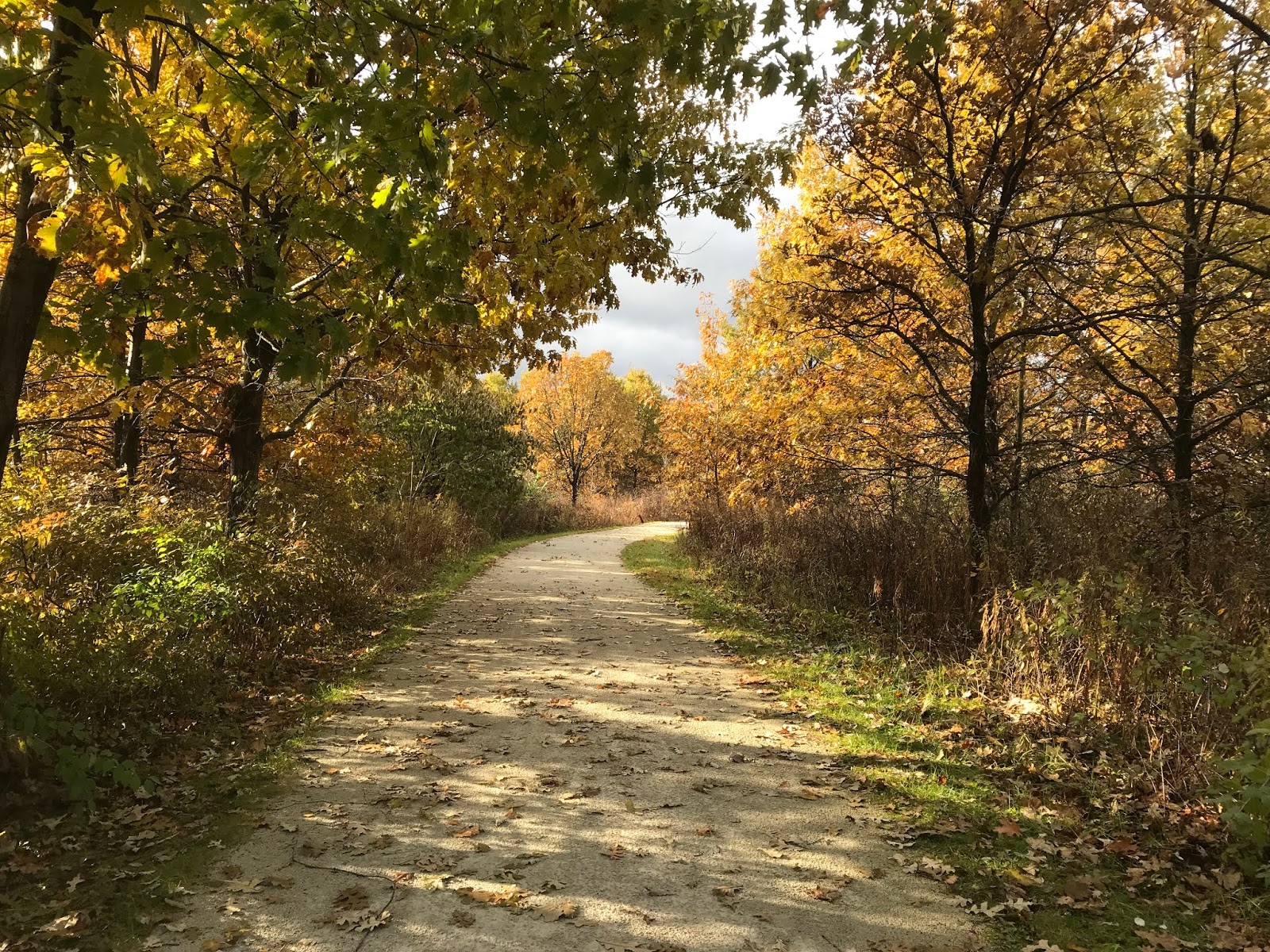
This weekend I was fortunate to be able to get out and ramble through local woods with good friends. The maples and oaks are putting on a fine show in all colors of orange, yellow, sienna, mahogany, and red. I think color shows better on cloudy days when you come around a corner and suddenly you encounter the flame-orange of a sugar maple in all its glory. This year, though, the oaks are stealing the spotlight.

A sudden glimpse of sun lights the treetops.

My dear friend Edith encouraged us all to capture a falling leaf, ensuring that we would have a year without colds if we did. It reinforced my desperate lack of athleticism and grace, but I managed to finally catch a bur oak leaf. The laughter was perhaps the best part of the exercise and we were certainly warmed by the chasing.


For me, a walk in the woods on an autumn day invigorates all five senses. The susurration of shuffling through dried leaves is a distinctive music. Cold air nips at your nose and the fragrance of leaf mold and bark seeps into your skin. My katsura (Cercidiphyllum japonicum) is beginning to perfume the yard. As its leaves turn apricot gold and fall away, they smell of cooked sugar with a touch of spice. It lingers on the back of your tongue. I like to press palms against the rough hewn bark of oaks and see if I can connect with the hamadryad inside. And of course, trees are a visual feast.

 Helllooooo beautiful!

I hope you get a chance to get out and explore all the delights of autumn this year. Bring a friend and find a special memory in the form of a tree.


Tuesday, July 10, 2018

Notes from the Rain Garden

It's pretty lush out here.

There was rain in May, about 10 inches over average. My yard has taken on jungle qualities. The trees grew in feet, not inches. Everything is leafy and lush, including the rain garden.

The fountain continues to be a haven for birds. The sparrows have built a second nest in the lilac tree. I didn't realize how big a nest European sparrows build when they have the space. It's about the size of a volleyball. There are also catbirds, cardinals, mourning doves, downy woodpeckers, robins galore, a bluejay family, redtail hawks, the occasional grackle, and goldfinches. So, it's a bird-loud space.
Bee friend on coreopsis.

Finally, as July set in, we are seeing bees. It was a bit too quiet in May and June. Now the rain garden is literally humming. If you sit or stand next to it and listen, you can hear the buzzing. It's pretty cool, really.
Hello, there!

Monarch on Asclepias syriaca

Along with bees, have come butterflies. As you can tell, I've let the milkweed go a bit. I can't help myself. On the few occasions it's been pleasant enough to open the windows, my whole house is filled with the fragrance of milkweed blossoms. We also have resident monarch butterflies. They've been laying a series of eggs, but the bird pressure is too high and we don't have caterpillars for long. I think the black swallowtails found the fennel finally. It's a happening place, the rain garden.