Wednesday, January 26, 2011

Tough, But Lovely: Native Plants


Prairie dock in all its lusciousness!
There has been much discussion of native plants around the water cooler recently.  As gardeners, many times we have a love-hate relationship.  We love that our native plants are tough and drought tolerant, but sometimes they are just too aggressive. Cup plant (Silphium perfoliatum) is magnificent - six or so feet tall, straight stems, bright green leaves, yellow daisy flowers.  Its leaves cup around the stems collecting rain for the birds and insects and goldfinches gorge on its seeds.  However, it will take over a regular garden bed.  One of its cousins, prairie dock (Silphium terebinthinaceum) will stay put and produce huge leathery leaves that follow the sun.  It's got a big tap root, too.

So, how do we encourage folks to plant more natives and yet avoid the stigma of weeds?  Native plants feed more birds and more insects (especially butterflies) than foreign cultivars.  Our prairie plants tend to be large, but you will get season-long flowers if you mix them.  Our woodland wildflowers are stunning, but fleeting.  There are few things more lovely than a hillside covered in spring wildflowers. 

Perhaps we need to not only educate ourselves and our neighbors, but elevate our native plants to their rightful place in designs.  How odd is it that Europeans have cherished and cultivated our native plants for centuries, but only recently has purple coneflower taken the stage?  Our Chicago area natives offer some of the most stunning fall colors, too.

Seek out natives at your local garden center.  If more folks ask for them, more retailers will carry them.  Also, investigate The Morton Arboretum, Chicago Botanic Garden, forest preserves, and other natural areas to see them up close and personal.  When planted in the right place, our natives are magnificent garden plants.

What an elegant collection of natives! 
This garden is butterfly heaven


Friday, January 21, 2011

It's Gardening Weather!


As you may have figured out from this blog, gardeners have a much different perspective on the weather. So it's January - what do gardeners in the know want weather-wise this time of year? Negative temperatures.  Why?  To kill stuff.  I was at Mid-Am, the horticultural trade show in Chicago, yesterday and sat in on a great refresher class by Dr. Frederic Miller of Joliet Junior College and The Morton Arboretum.  He reminded us that insect pests can be negatively impacted by opportune weather conditions.  What does that mean?  If we get periods of several days in the negative temps, it can kill off some of those nasties that trouble us during the growing season.  That's good news!  Less bugs eating my plants and fewer people spraying dubious products.  Break out the wooly socks and cuddle up with the pets!

Wednesday, January 12, 2011

Thoughts of Spring in a January Snow


We got about five inches of powder last night and as I was shoveling the driveway this morning, I was fondly remembering our trip to Volo Bog this past May.  It was that perfect sort of day - not too hot and not too cold.  Plants were bursting out of the ground, birds were singing, and frogs jumping.  We saw a couple of sandhill cranes hiding in the rushes and pretty much had the place to ourselves.  I was in seventh heaven because this wonderful bog is filled with plants that I don't know the names of.  They have a very nice visitor center with kind staff who put up with plant geek me.  If you're looking for a day trip, I highly recommend it, just keep in mind some of the floating boardwalks might get a bit tricky.  They can be a bit warped in places, but it is amazing to be able to walk out over this rare type of quaking bog.

Remember robins?

Shooting star or Dodecatheon meadia, one of our native wildflowers.


The lush path 

Wednesday, January 5, 2011

Herbs in Winter Continued - and Recipes!

Winter savory - a bit freeze dried, but still good!
We had our typical January thaw a bit early this year, so instead of a nice six inches of snow, we're back to bare ground.  Sigh.  Snow = mulch!  We also have made the decision to swap the bedrooms so (at last!) I'll have a south and a southeast window to grow things!  And I can still raid my mother-in-laws greenhouse.  She planted pots and pots of herbs this year for winter cooking and I've lost count of how many varieties of basil she's growing. I also noticed that the packaged fresh herbs in our little local produce stand were only a couple of bucks.

At any rate, I can now get at the winter and summer savory plants which are pretty much evergreen. Savory is a woodsy, piney, spicy herb similar to thyme and marjoram and is perennial.  We'll use it in soups, stews, shepherd's pie, and anything that lends itself to a richer flavor.  I've even tossed summer savory into pasta salads.  We've found that you can dress up almost anything with a bit of fresh herbs, especially things like bottled pasta sauce and frozen pizza.  Be fearless!  Fresh herbs can really brighten your meals.

Easy Pasta Sauce

1 Tblsp olive oil (enough to coat the bottom of the sauce pan)
1 - 2 garlic cloves chopped fine
1 small onion chopped
1 large tomato chopped OR 1 can of chopped tomato
1/2 cup red wine
1/4 cup chopped fresh herbs - parsley, rosemary, savory, or basil
1 jar of bottled tomato pasta sauce
salt and pepper to taste

Coat the bottom of the sauce pan with olive oil and allow to heat so that you can see ripples in the oil.  Add onion and allow to cook until softened.  Add garlic and cook for about 30 seconds until fragrant.  Add tomato, wine, and herbs (unless you're using basil, hold on to that one).  Allow to cook down until about half the amount you started with.  This concentrates your flavors and reduces the water content.  Add bottled sauce and stir.  I like to rinse out the last of the sauce in the jar with additional red wine.  Simmer for about 10 minutes for flavors to meld.  Add basil just before serving.

If you are growing fresh basil on your windowsill, here's a summer favorite to try on those single digit days. It makes a large batch, perfect for entertaining.

Summer Bruschetta

4 tomatoes, diced
¼ red onion, diced
1 small clove garlic, finely chopped
1 cup mozzarella, diced
2 tablespoons olive oil
1 tablespoon balsamic vinegar
1/3 cup fresh basil, chopped

Blanch garlic clove by pouring boiling water over it and letting it steep for 30 seconds before plunging it into cold water. Often, placing it on a skewer works well. This reduces the sharpness of the flavor. Dice tomatoes, onion, and mozzarella to a similar size. Combine all ingredients, and toss with the olive oil and vinegar. Serve on sliced toasted bread. Alternately, you may choose to add sprigs of basil over the tomato mixture just before serving.


Thursday, December 30, 2010

Herbs in Winter

We love love love to cook.  The husband has culinary experience and over the past (almost) fifteen years of marriage, he has managed to teach me to cook.  And we haven't killed each other.  Yet.  This year I bought him a rice cooker for Christmas and we've already broken it in.  He's not necessarily a big cooking gadget person, although we do own and use a fish poacher and a mandoline.  For example, he's in the midst of the Bread Project which involves various sourdough starts and lots of bowls of mystery dough in the fridge.  It makes amazing bread, though, and without a bread machine. 

One thing we struggle with is growing herbs indoors.  We just don't have a south facing window with any sort of ledge or good access to sun.  Over the past few years, we have greatly expanded the range of herbs we grow and use, so it's a bit frustrating to have to buy fresh when I can walk out the back door in the summer and snip away.  This is the fennel.  Last year's winter was fairly mild, so it came back - much to my surprise! It got about six feet high before keeling over under the weight of the seeds.  It's also a host plant for butterfly larvae, so I let it reseed. 

This year, we are again trying to keep the rosemary going.  It is toughing it out on the dining room table in afternoon sun.  It isn't happy, but it has grown!

Friday, December 24, 2010

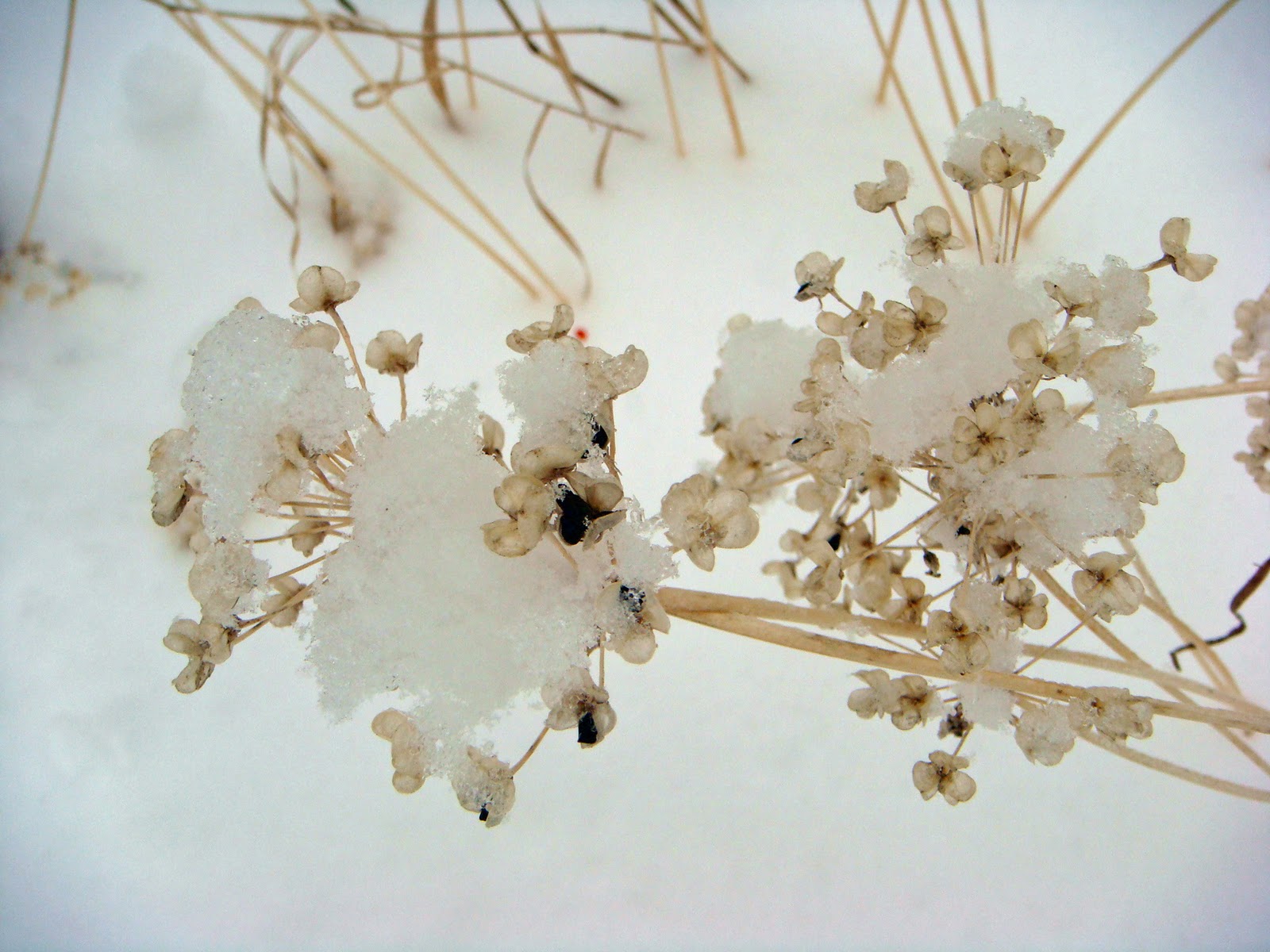
Elegant Alliums in Winter

As designers and horticulturists we go on at length about creating winter interest.  Here in the Chicago area, our winters can be pretty long and bleak, so we need to be creative in the garden to keep from going completely round the bend.  One of those tricks knowing gardeners do, is leave perennials up for the winter.  They provide structure, seeds, and interesting silhouettes. 

This is a fall blooming allium or ornamental onion

See how lovely this is in a fresh snowfall?  The seeds feed the birds and the delicate dried petals give you a glimpse of the flower that bloomed months ago.

Saturday, December 18, 2010

Tree Man

Today we are celebrating my father's 70th birthday.  It'll be a big party with lots of family and friends.  One thing my father taught me was a love of trees.  I come by this horticulture bug quite naturally.  Dad would take the family and the dog out on hikes at the local forest preserves and the arboretum most weekends.  We lived only a few blocks from a large forest with extensive trails for hiking and biking.  Dad worked in construction and would often tote home logs for the fireplace if the project required tree removal.  In our own yard, he's planted many many trees through the almost 40 years in the house.  The parkway trees have changed from a lone large ash to a maple and a pear, both of which are looking dodgy.  The front yard is graced by a crimson maple the folks planted when they first moved in.  As a kid we had a huge crabapple on the corner of the house right outside my bedroom window.  I adored it.  It had white fragrant flowers and apples big enough that Mom made jelly out of them now and again.  Of course it eventually succumbed to apple scab and so Dad replaced it with a hedge maple. 

The backyard trees are doing their best to kill the lawn.  These are his pride and joy.  There's the American elm that was planted when they moved in and has toughed it out through Dutch elm disease all over the village.  The spruces offer cover for birds and screening from the neighbors. The katsura is coming along nicely, now that an ash is gone.  There's even a swamp white oak sapling in the back corner that he started.  However, above all of these is Dad's pride and joy - the shagbark hickory he raised from a nut.  Now it hasn't quite started to shag yet, but it does produce a handful of nuts much to the squirrels' delight.  It also gets a couple of hickory pests and diseases, so, well, it's a little wonky.  The trunk has some kinks from losing the leader, but the tree still grows like crazy.  I think Dad calls the Morton Arboretum plant clinic each year with an update on what attacks it.  The shagbark just shrugs it off and keeps on going.  My brother and I think it might be his third child.

So today, I remember climbing all the trees on our block I could get into.  I remember Dad pointing out the magnificent oaks in the forest preserves.  I remember him planting a bur oak at grandma's house and an Accolade elm because she needed some trees on her rather barren patch.  My uncles have trees from Dad as well as neighbors and friends.  We have discussions on pruning and this Thanksgiving we spent an hour with the ladder and the pruning saw, taking the katsura off the garage roof. The latest challenge is finding a home for a black walnut sapling that appeared in the compost pile.  It's already survived some rabbit pruning and I think I may have found someone who will plant it and love it, just not as much as Dad.